<?xml version="1.0" encoding="utf-8"?>
<feed xmlns="http://www.w3.org/2005/Atom">
  <title>Open Home Foundation Blog</title>
  <subtitle>News and updates from the Open Home Foundation</subtitle>
  <link href="https://www.openhomefoundation.org/blog/feed.xml" rel="self"/>
  <link href="https://www.openhomefoundation.org/blog/"/>
  <updated>2026-07-31T00:00:00Z</updated>
  <id>https://www.openhomefoundation.org/blog/</id>
  <entry>
    <title>A big win for Android interoperability</title>
    <link href="https://www.openhomefoundation.org/blog/a-big-win-for-android-interoperability/"/>
    <updated>2026-07-31T00:00:00Z</updated>
    <id>https://www.openhomefoundation.org/blog/a-big-win-for-android-interoperability/</id>
    <author><name>Timothy Nibeaudeau</name></author>
    <summary>Google gatekept key Android features, and the European Commission asked what we thought about it. Now Alphabet must open 11 Android features to all.</summary>
    <content type="html"><![CDATA[<p>Something big just happened. As the Open Home Foundation’s Android developer for Home Assistant, I was invited by the European Commission (EC) to <a href="https://digital-markets-act.ec.europa.eu/dma100220-consultation-proposed-measures-interoperability-google-android-article-67-dma_en" target="_blank" rel="noopener noreferrer">consult on Android interoperability</a>. The call for feedback was part of the Commission’s work under the <a href="https://digital-markets-act.ec.europa.eu/index_en" target="_blank" rel="noopener noreferrer">Digital Markets Act</a> (DMA). For anyone unfamiliar, the DMA is an <a href="https://eur-lex.europa.eu/legal-content/EN/TXT/?uri=uriserv:OJ.L_.2022.265.01.0001.01.ENG#006.007" target="_blank" rel="noopener noreferrer">EU law</a> that defines and regulates “gatekeeper platforms” – those that offer “core” services like search engines, app stores, and messaging platforms – to make digital markets fairer and more open to competition. As you might imagine, I had <em>plenty</em> to say about Google’s restrictions on Android, especially the tech giant limiting wake word detection to its own Gemini assistant, a concern I surfaced in our <a href="https://www.youtube.com/live/AQOzKdvO97s?t=2193" target="_blank" rel="noopener noreferrer">Home Assistant 2026.3 Release Party</a>. To put it plainly, Google had no grounds for limiting Android interoperability in the first place, other than to give itself the upper hand. We knew our community deserved better, and that’s what we told the Commission.</p>
<p>The result? The EC listened to us and all the other organizations that contributed. On July 16, 2026, the European Commission adopted a decision under the DMA that requires Alphabet (Google’s parent company) <a href="https://digital-markets-act.ec.europa.eu/developer-portal/interoperability/alphabet-specification-proceedings-interoperability-ai-services_en" target="_blank" rel="noopener noreferrer">to open up eleven Android features</a>, including always-on wake word detection, ambient sensor access, and screen automation – to all assistants, on equal terms.</p>
<p>As an EU citizen, I’m genuinely pleased to see this kind of regulation of Big Tech leveling the digital market playing field and representing real progress for users. Not only that, but it’s a real win for the Open Home Foundation: we exist to fight for privacy, choice, and sustainability in smart homes, and this outcome shows what’s possible when we advocate for our community. We already briefly covered this news in our <a href="https://newsletter.openhomefoundation.org/the-walled-garden-thats-breaking-down-barriers/" target="_blank" rel="noopener noreferrer">July newsletter</a>, but I want to take some time now to break down how we got here, what this decision says, why it matters for our community, and what it could unlock for Home Assistant and the rest of the industry.</p>
<!--more-->
<h2>A bit of background</h2>
<p>For three years, our community had tried to ship an always-on wake word detection in the Android <a href="https://play.google.com/store/apps/details?id=io.homeassistant.companion.android&hl=en" target="_blank" rel="noopener noreferrer">Home Assistant Companion app</a>. We wanted users to be able to say “Okay Nabu,” and have their self-hosted <a href="https://www.home-assistant.io/voice_control/" target="_blank" rel="noopener noreferrer">Assist</a> voice assistant answer. Yet our early attempts kept breaking. Most notably, after each reboot the device's microphone no longer picked up the wake word. So we dug into the Android source code, and lo and behold, there was a solution: but Google wasn’t letting us use it.</p>
<p>Android has a well-designed mechanism that lets your device listen for “Hey Google” all day, without draining your battery. Their wake word detection runs in two stages. A small model does the first detection on a DSP (digital signal processor), which is a dedicated chip that processes audio using a fraction of the power your device’s main processor (CPU) would need. This first stage runs in an isolated process blocked from the network, and can’t extract audio until a potential wake word is detected. Then the second stage uses a stronger model via the CPU to confirm the detection.</p>
<p>Most contemporary devices have DSPs. But Android-based devices block access to it for anyone other than Google and the manufacturer of the device. Since the wake word mechanism using the DSP simply wasn’t available to third-party apps, and developer documentation didn’t exist publicly, we used what we could to build a workaround.</p>
<h2>From microWakeWord to macro results</h2>
<p>Our solution was running a small <a href="https://github.com/OHF-Voice/micro-wake-word" target="_blank" rel="noopener noreferrer">microWakeWord model</a> on the device’s CPU inside our app. This worked, but came with some big downsides:</p>
<ul>
<li>Battery usage would jump from roughly 1% to 15% with wake word detection enabled, since the CPU is far less efficient for this task.</li>
<li>The microphone privacy indicator (the green dot) would stay on permanently, because we needed full microphone access to run detection ourselves. We actually think the indicator is the right design – the problem is that we had no way to offer the stronger guarantee Google gives itself: an isolated process that can’t send audio anywhere. Instead, you had to trust that we were handling that access responsibly. And not because a safer version isn’t technically available. But because the DSP path is arbitrarily blocked by Google for anticompetitive reasons, forcing a less secure approach that introduces privacy risks for the user.</li>
<li>You would have to set Home Assistant as your default assistant, because that was the only way Android would keep our service alive across reboots. That would lock you out of Gemini and everything tied to it (and you shouldn’t have to choose).</li>
</ul>
<p>When I was invited to share these limitations (and others) with the Commission, I didn’t hold back. Which is why we were thrilled to discover an impressively precise and technically accurate decision from the EU: it correctly describes the two-stage wake word architecture, the DSP, the isolated process, and the role coupling. The report went down to details we only figured out by reading Android's source code ourselves. Which brings us to what the ruling actually says…</p>
<h2>A wake-up call for Google</h2>
<p>The decision requires Google to give third parties interoperability that’s “equally effective” as what Google’s own assistant gets across eleven Android features, free of charge. For wake word detection specifically, Google must provide:</p>
<ul>
<li>The ability to create a custom wake word model in Android, with first-stage detection run by the DSP (when available) instead of the app</li>
<li>The ability to run a second-stage validation after the DSP has potentially identified the wake word in first-stage detection</li>
<li>Testing tools and complete documentation, without requiring a commercial agreement with Google</li>
</ul>
<p>Two lines deserve a special mention. First: Google “shall not subject access to features to the app holding a default role, including the default assistant role.” That is the decoupling we discussed with the Commission. Second: wake word detection “from multiple services, including services belonging to third parties and Alphabet, are able to run concurrently.” This would let you say “Okay Nabu” to control your home without changing any defaults or having to give up using Gemini for other purposes.</p>
<p>Beyond wake words, the decision covers invoking assistants from the long-press home gesture, access to ambient data like the microphone and camera under the same conditions as Google, structured integration with apps (including Gmail, Calendar, and Maps), system-level controls, access to on-device AI models, and fair background execution rules. Opening up these features hasn’t been without pushback – Google itself has raised security concerns, which we’ll get into below. But with all things considered, we believe the benefits to users and the industry far outweigh the risks.</p>
<h2>Time’s ticking</h2>
<p>Google must ship these changes in Android 18 (the next major release), by August 1, 2027. Concurrent hotword detection – letting multiple services be triggered by voice – must be in place by Android 19, no later than August 1, 2028.</p>
<p>It’s worth noting the decision still relies on Google to design and implement the changes, and with that comes a risk of malicious compliance: a technically sound solution that is unusable in reality (it wouldn’t be the first time a gatekeeper wrangled its way out of a regulation). But the fine print gives grounds for hope: Google must deliver solutions that are “equally effective” on ease of use, speed, and energy consumption, publish complete documentation and testing tools, and report progress to the Commission monthly. A real win for developers, and one that makes shipping the bare minimum much harder to get away with. With that in mind, here’s what it could look like for Home Assistant.</p>
<h2>Help us make this change stick</h2>
<p>We’re always working hard to create the best possible experience for our Android Home Assistant users, though we’re a small team – which is why community contributions to the <a href="https://github.com/home-assistant/android" target="_blank" rel="noopener noreferrer">Android app</a> matter so much. If you’d like to help (in line with our recently released <a href="https://github.com/home-assistant/android/blob/main/AI_POLICY.md" target="_blank" rel="noopener noreferrer">AI policy</a>), we’d love to hear from you. While the ideas below are just that, and don’t form part of our roadmap, your input could help unlock them in the future:</p>
<h3>Battery-efficient wake word detection</h3>
<p>Like we mentioned earlier, moving first-stage detection from the CPU to the DSP should increase battery efficiency significantly. Our plan is to support two methods: on newer phones with Android 18, we’ll use the phone’s low-power chip to listen for the wake word. On older phones, or those without that chip, detection will keep running as it does today. Either way, we’ll show you which method your phone is using from within the Companion app.</p>
<h3>One phone, two assistants</h3>
<p>Today, choosing a third-party wake word means giving up Gemini, along with calls and messages through your default assistant. Default-role decoupling and concurrent wake word access would end that: You can talk to Gemini like aways, but also say “Okay Nabu” when you want to interact with your home via Home Assistant.</p>
<p>Imagine if you could set different wake words for different assistants inside the app itself, like “Hey Jarvis” for your admin dashboard and “Okay Nabu” for the family. This won’t even be technically possible until 2028 when Android 19 is released (and it will take a lot of work), but it’s a nice goal to have looking ahead.</p>
<h3>Better built-in privacy</h3>
<p>This is the part I find most exciting. The ruling requires wake word confirmation to run in a secure, isolated process (known as sandboxing) via the DSP. This means the part of the system that controls this feature is walled off, with no way to send audio anywhere until the wake word is confirmed. I don’t want to rely on trust when it comes to something as sensitive as interactions with my voice assistant. I want to be in control, with a clear explanation of what the things I enable actually imply. Sandboxing gives us that by design: privacy enforced by the OS itself, the same secure-by-default protection Google has always had, now finally available to all.</p>
<h3>A more capable assistant, for everyone</h3>
<p>Sensor access isn’t the only place this equal treatment applies. The decision also requires Google to open structured integrations with its own apps – Gmail, Calendar, Maps, etc – to qualified assistants, not just Gemini. In theory, that means your assistant could draft an email, manage a calendar event, or send a text and start a call on your behalf: exactly the capabilities our users tell us they miss when they leave Gemini, and ones that could genuinely boost usability, especially for users with accessibility needs.</p>
<p>That same access could expand the range of sensors and controls the app already reports to Home Assistant: sound detection (smoke alarm, breaking glass, doorbell) as automation triggers, and controls like do-not-disturb or Bluetooth your assistant can actually act on, not just observe.</p>
<h2>On the security argument</h2>
<p>Google has <a href="https://blog.google/company-news/inside-google/around-the-globe/google-europe/the-dma-should-not-undercut-security-privacy-for-europeans/" target="_blank" rel="noopener noreferrer">pushed back on the ruling, citing security risks</a>. It warns the decision grants third parties “sensitive and powerful device permissions,” exposing user data “without user knowledge or consent.” This framing overstates the risks in a familiar tactic: sounding the alarm on security concerns to curtail attempts for interoperability. We’d point out, as one of those third parties, that the decision already builds in the safeguards that concern calls for: Google can still require user consent, show privacy indicators, and let users revoke access per service. For the most sensitive features like health data access, it also has a policy in place via the Play Store to check security, privacy, and data minimization before any app gets access.</p>
<p>And to be clear, these capabilities already exist on your phone, and Google’s own services already use them, without ever asking your approval. The risk didn’t appear when the EU asked for that access to be shared more broadly – what changed is who gets to decide who has it. Whatever risks remain, like those introduced by using <em>any</em> smart device, should be taken seriously – just not as a veil for Google’s double-dealing.</p>
<p>Our view is that trust without verification isn’t a security model, and limiting these safeguards to Google alone isn’t protection. Even major AI vendors have had security incidents, <a href="https://openai.com/index/hugging-face-model-evaluation-security-incident/" target="_blank" rel="noopener noreferrer">Hugging Face/OpenAI</a> among them. What does offer protection is giving users choice and transparency into security processes, along with a secure technical architecture: sandboxing, isolation, revocable permissions – enforced equally, which is what this decision requires.</p>
<p>It’s worth watching where Google goes next: from 2027, its developer verification program will require every Android developer to be centrally verified before their apps can even be installed – a move contested by the <a href="https://keepandroidopen.org/" target="_blank" rel="noopener noreferrer">Keep Android Open</a> campaign, and one we’re also skeptical about. It’s a reminder that this fight isn’t over, and neither is our work.</p>
<h2>There every step of the way</h2>
<p>Google must report its implementation plans to the Commission within two months, and eligibility program terms are due for public consultation by February 2027. We’ll be there for it all: to test the betas, report on whether implementation lives up to the promise, and keep you informed. In the meantime, we’ll continue doing all we can to champion smart home tech that’s private, local, and controlled by you, on <em>your terms.</em></p>
]]></content>
  </entry>
  <entry>
    <title>Making our web analytics open source with Plausible</title>
    <link href="https://www.openhomefoundation.org/blog/making-our-web-analytics-open-source-with-plausible/"/>
    <updated>2026-07-29T00:00:00Z</updated>
    <id>https://www.openhomefoundation.org/blog/making-our-web-analytics-open-source-with-plausible/</id>
    <author><name>Darren Griffin</name></author>
    <summary>Find out how and why we’re implementing analytics on our websites: via open source software with no personal data collection or tracking.</summary>
    <content type="html"><![CDATA[<p>The Open Home Foundation fights for privacy, choice, and sustainability. These principles are at the heart of everything we do, including how we handle website analytics.</p>
<p>Our position is clear: we reject tools that track individuals across the web to monetize their data. Instead, we want aggregated, anonymized analytics to show us how our websites are performing overall. This gives us the insights we need to effectively maintain the foundation’s websites without identifying who our visitors are, or compromising their privacy.</p>
<p>In this article we’ll explain how we plan to do this with Plausible analytics: open source software where you can see exactly what we see on a public dashboard and block altogether if you wish.</p>
<p><strong>Please note: the following information only applies to Open Home Foundation websites, <em>not</em> Home Assistant software, your local instance, or any data from your home.</strong></p>
<!--more-->
<h2>Aggregated, anonymized analytics</h2>
<p>Plausible shows us aggregate totals of website activity, not individual behavior or personal information. Here’s what that looks like, with links to the relevant information in Plausible:</p>
<table>
<thead>
<tr>
<th style="text-align:left">What is tracked</th>
<th style="text-align:left">What is not tracked</th>
</tr>
</thead>
<tbody>
<tr>
<td style="text-align:left"><a href="https://plausible.io/docs/metrics-definitions#unique-visitors" target="_blank" rel="noopener noreferrer">Which pages get visited and how often</a></td>
<td style="text-align:left"><a href="https://plausible.io/when-not-to-use-plausible#plausible-is-not-for-tracking-individual-users" target="_blank" rel="noopener noreferrer">Individual visitor profiles or identities</a></td>
</tr>
<tr>
<td style="text-align:left"><a href="https://plausible.io/docs/countries#how-location-reporting-works" target="_blank" rel="noopener noreferrer">Approximate geography (country/region level)</a></td>
<td style="text-align:left"><a href="https://plausible.io/data-policy" target="_blank" rel="noopener noreferrer">Cross-session or cross-day visit history</a></td>
</tr>
<tr>
<td style="text-align:left"><a href="https://plausible.io/docs/top-referrers#sources" target="_blank" rel="noopener noreferrer">Referral sources (where visits come from)</a></td>
<td style="text-align:left"><a href="https://plausible.io/when-not-to-use-plausible#plausible-is-not-a-session-replay-or-heatmap-tool" target="_blank" rel="noopener noreferrer">Session replays or heat maps</a></td>
</tr>
<tr>
<td style="text-align:left"><a href="https://plausible.io/docs/metrics-definitions#engagement" target="_blank" rel="noopener noreferrer">Basic engagement metrics (time on page, scroll depth)</a></td>
<td style="text-align:left"><a href="https://plausible.io/privacy" target="_blank" rel="noopener noreferrer">Data sold or shared with third parties</a></td>
</tr>
<tr>
<td style="text-align:left"><a href="https://plausible.io/docs/custom-event-goals" target="_blank" rel="noopener noreferrer">Custom events like button clicks (downloads, sign-ups)</a></td>
<td style="text-align:left"><a href="https://plausible.io/security#personal-data" target="_blank" rel="noopener noreferrer">IP addresses (used briefly for geolocation, then deleted not stored)</a></td>
</tr>
<tr>
<td style="text-align:left"><a href="https://plausible.io/data-policy" target="_blank" rel="noopener noreferrer">Browser name and version, operating system name and version, and device category (desktop/mobile/tablet)</a></td>
<td style="text-align:left"><a href="https://plausible.io/data-policy" target="_blank" rel="noopener noreferrer">Fingerprinting signals such as screen resolution, fonts, or timezone collected from your browser</a></td>
</tr>
</tbody>
</table>
<h2>Giving you control</h2>
<p>Our Plausible dashboard is public, so you can see exactly the same information as us – and we’ll provide the link at the bottom of every Open Home Foundation website using Plausible so everyone can access it. As part of our broader effort to align our websites with our principles, we’re also making sure any affiliate links and other tracking elements are removed.</p>
<p>The system doesn’t create persistent identifiers*, any other cross-site or cross-device tracking, or use cookies – which means no consent banners cluttering up your screen, and no way to recognize users across visits. However it also means that if you prefer not to be part of the aggregated statistics, you’ll need to block Plausible using your ad blocker rather than clicking a preference box. Many ad blockers already filter it automatically. If yours doesn’t, here’s how to add it:</p>
<pre><code>||plausible.openhomefoundation.org/js/pa-*
</code></pre>
<p>If your ad blocker is blocking Plausible by default and you want to make an exception for our websites, you can use the following filter to enable it just for us:</p>
<pre><code>@@||plausible.openhomefoundation.org/js/pa-*
</code></pre>
<p>*Plausible counts unique visitors using a <a href="https://plausible.io/security#personal-data" target="_blank" rel="noopener noreferrer">24-hour session hash</a>.</p>
<h2>How we’re using Plausible</h2>
<p>We’ve chosen Plausible because its philosophy aligns with our own privacy principles, and we’re taking extra steps to customize it further. We’re hosting it on infrastructure we maintain in-house, which means we have full control over the anonymous, aggregated data and how it’s handled. We’ve turned off journey tracking features, and while <a href="https://plausible.io/docs/countries#how-location-reporting-works" target="_blank" rel="noopener noreferrer">Plausible uses IP addresses for</a> geolocation, they are discarded and never stored.</p>
<p>Most analytics services collect personal data that privacy regulations – such as GDPR in Europe – require them to delete, typically after one to two years depending on jurisdiction. But since Plausible only provides fully anonymized data with no personally identifiable information, we can keep it indefinitely. This way we (and anyone viewing our public dashboard) can see how things change over time, and spot long-term trends that suggest what’s working and what needs improvement.</p>
<h2>Why we need analytics</h2>
<p>The Open Home Foundation is a non-profit responsible for fulfilling our mission: fighting for privacy, choice, and sustainability in smart homes. A key part of this is advocacy – making sure as many people as possible know about our work and the alternatives we’re building to Big Tech control. This means running multiple project and organizational websites, managing partnerships that fund our work, and allocating limited resources effectively.</p>
<p>As we’ve grown, we’ve reached a point where we have so many website visitors it’s impossible to ask them all basic operational questions about the websites we run, such as which browser versions to prioritize testing, whether our getting started guides are being found, or how to allocate maintenance effort across projects.</p>
<p>Without this information, we risk wasting resources on the wrong priorities.</p>
<p>Analytics helps us with:</p>
<ul>
<li>Technical optimization (browser compatibility, performance, maintenance)</li>
<li>Resource allocation across projects</li>
<li>Commercial sustainability (our store and links to our licensed products that help fund the foundation)</li>
<li>Infrastructure and cost management</li>
</ul>
<p>All these things inform our technical decisions, help us prioritize where to invest funds, and ensure we’re using our resources where they have the most impact.</p>
<p>For example: a key goal for 2026 is to make our projects more approachable for everyone – from experienced users to those just starting out. Using analytics will show us if beginners are finding our simplified guides or still getting lost in advanced documentation.</p>
<h2>What we’ve been doing</h2>
<p>Until now, the only data for our websites we could view was basic server-side usage information like page visit counts. This doesn’t sit well with us, since our users can’t see that data, or opt out of it unless they stop using our sites altogether! Which is why we’re moving to Plausible.</p>
<h2>What happens next…</h2>
<p>We’re implementing Plausible over the next few months. You’ll see the dashboard link appear at the bottom of pages as it goes live.</p>
<p>We’ve taken care to align this work with our values, but we want to hear from you: if something concerns you or you have suggestions for how we could do this better, let us know.</p>
]]></content>
  </entry>
  <entry>
    <title>Building the device database together: Public preview now live</title>
    <link href="https://www.openhomefoundation.org/blog/building-the-device-database-together/"/>
    <updated>2026-07-23T00:00:00Z</updated>
    <id>https://www.openhomefoundation.org/blog/building-the-device-database-together/</id>
    <author><name>Matthias Kerstner</name></author>
    <summary>Explore the preview edition of our community-powered smart home device database. We need your input to make this tool as accessible and useful as possible.</summary>
    <content type="html"><![CDATA[<p>Ever since we introduced the idea of a community-powered device database at State of the Open Home 2025, our goal has been clear: create a “Wikipedia of smart home devices” based on real-world usage. In February, we took the first step by <a href="https://www.home-assistant.io/blog/2026/02/02/about-device-database/" target="_blank" rel="noopener noreferrer">inviting Home Assistant users</a> to voluntarily share anonymized device data to help us build it.</p>
<p>Back then, we said we wouldn’t hide behind closed doors until we’d polished some “perfect” final product, and we meant it. At the Open Home Foundation we build in the open. That means sharing our process, our progress, and every milestone along the way with the community that makes it all possible.</p>
<p>So today I’m excited to share the next milestone. The seeds we planted in February have started to sprout: thanks to the incredible response from thousands of users who opted to share anonymized device data during the initial phase, the <a href="https://device-database-preview.openhomefoundation.org" target="_blank" rel="noopener noreferrer">preview edition of the database’s public interface</a> is now live!</p>
<!--more-->
<h2>What is the preview edition?</h2>
<p>Providing a public, open way to browse the anonymous, aggregated device data we collect was always part of the plan, and this preview is our first step toward it.</p>
<p>You can already use it to search and filter devices to see aggregated community insights, starting with a deliberately focused set of specifics, such as whether a device requires an internet connection, and which protocols and integrations it works with. We’ve kept that initial scope narrow on purpose, giving us a solid foundation we can build on together with you, our community, as the database grows.</p>
<p>What you see today is only a slice of what’s to come, and we want to be upfront about that. Yes it’s functional, but it’s unpolished. There are no final design flourishes, and we’re sure there are a few bugs waiting to be discovered. We don’t even have an official name for it… yet. But we’d rather you experience it now than wait for the full picture before opening the doors.</p>
<p>So please, jump right in.</p>
<h2>Help us test it</h2>
<p>This is a resource built <em>by</em> the community, <em>for</em> the community, so we want you to start using it now. The more you explore it today, the more powerful we can make the official launch later this year.</p>
<p>It’s the baseline everything else builds on, where you can browse, search, and read device data, and it’s the groundwork for the richer pages and community contributions still to come.</p>
<p>As you explore the preview, we’d love your help tracking down areas where we can improve. We’ve set up a dedicated <a href="https://discord.com/channels/330944238910963714/1463602457924997236" target="_blank" rel="noopener noreferrer">feedback channel on Discord</a>, and that’s the best place to share your thoughts so everything lands in one spot. A few things we’re especially keen to hear about:</p>
<ul>
<li><strong>What’s missing for you:</strong> Which device details would help you make a decision, and what extra features or information would make the database more valuable to you?</li>
<li><strong>Interface usability:</strong> How easy is it to navigate, search, and make sense of device information, and did you hit any hurdles or confusing moments along the way?</li>
</ul>
<p>Big reactions or small ideas, what you’d keep or what you’d change: all of it helps. <a href="https://discord.com/channels/330944238910963714/1463602457924997236" target="_blank" rel="noopener noreferrer">Head over to the discussion</a> and let us know what you think.</p>
<p>A couple of things you might notice along the way:</p>
<p><strong>Can’t find a specific device?</strong> To ensure data quality and accuracy, devices only appear in search results once enough independent submissions have been aggregated and validated. Additionally, during this early phase, custom integrations and service-type devices are not yet included.</p>
<p><strong>Want to edit or add device details directly?</strong> Direct contributions to device pages, like adding context or correcting details, are firmly on our roadmap but a little further down the line. Right now the focus is simply making the data collected so far accessible and useful to everyone.</p>
<p>So for now, take it for a spin and let us know what you think. Like I said back in February, this is a marathon, not a sprint, and your feedback will directly shape the final product!</p>
<p style="text-align: center; margin-top: 40px;"><a href="https://device-database-preview.openhomefoundation.org" target="_blank" rel="noopener noreferrer" class="button" style="display: inline-flex;">Explore the preview</a></p>
<p style="text-align: center; margin-top: 16px;"><a href="https://discord.com/channels/330944238910963714/1463602457924997236" target="_blank" rel="noopener noreferrer" class="button" style="display: inline-flex;">Share your feedback</a></p>
]]></content>
  </entry>
  <entry>
    <title>IFA Berlin 2026: Save the date</title>
    <link href="https://www.openhomefoundation.org/blog/ifa-berlin-2026-save-the-date/"/>
    <updated>2026-06-30T00:00:00Z</updated>
    <id>https://www.openhomefoundation.org/blog/ifa-berlin-2026-save-the-date/</id>
    <author><name>Melissa Thermidor</name></author>
    <summary>Mark your calendars! From September 4 to 8, 2026, the Open Home Foundation will be exhibiting at IFA Berlin – and you’re invited.</summary>
    <content type="html"><![CDATA[<p>Save the date! Because from September 4 to 8, 2026, we’ll be exhibiting at <a href="https://www.ifa-berlin.com/" target="_blank" rel="noopener noreferrer">IFA Berlin</a> – one of the world’s largest home and consumer tech events – for the very first time 🎉</p>
<p>This marks a milestone for the Open Home Foundation, and one we can’t wait to share with you (and the trade show’s 220,000 visitors!). We’ll provide more information as the event nears, but in the meantime, here’s what you need to know…</p>
<img src="/assets/images/blog/ifa-berlin-2026-save-the-date/image1.webp" alt="A banner reads &quot;Save the date! We’re heading to IFA, 4-8 SEPT 2026,&quot; with the Open Home Foundation logo in the top left. The right side shows a photo of people walking past colorful IFA event flags on poles outside a convention center. Photo credit: IFA Management GmbH." style="border: 0;box-shadow: none;">
<!--more-->
<h2>A first for the foundation</h2>
<p>Making our IFA Berlin exhibitor debut is a huge opportunity to showcase what’s possible when privacy, choice, and sustainability are at the heart of smart home tech.</p>
<p>More than that, it’s a chance to connect with our community and industry partners on the ground, celebrate our projects, and show the world what an open, privacy-first, locally controlled smart home can look like in practice.</p>
<p>With the event’s Smart Home Hall drawing an estimated 40,000 visitors, we’re excited to spread the word about all things open source in the smart home.</p>
<h2>Come on in, the door’s open</h2>
<p>Our booth won’t be a standard trade show stand. That’s because <em>we’re</em> <em>not</em> a standard tech organization. Unlike our corporate counterparts, we’re not coming to IFA to sell you a product: we’re coming to <em>connect</em> – not only with our existing community, but with anyone curious about what the Open Home can be.</p>
<p>Amid the hustle and bustle of the trade show floor, our booth is designed as a sanctuary. A place for meaningful conversation and the exchange of ideas where you can feel at ease, and hopefully inspired!</p>
<p>Anyone can come by and speak to staff members, commercial partners, and community volunteers. Whether you’re there for a casual chat, to check out some demos and devices, or simply to say hello: at IFA Berlin, our home is your home. We can’t wait to welcome you in 🏡</p>
<h2>Join our Community Meetup</h2>
<p>And the fun continues off the show floor… On Sunday, September 6, at 7:00 pm, we’re gathering at <a href="https://www.google.com/maps/place/ENJOY+ROOFTOP+-+Event+Location/@52.5093906,13.2811552,17z/data=!3m1!4b1!4m6!3m5!1s0x47a851911f0c74c3:0x20d9cd9b23798590!8m2!3d52.5093874!4d13.2837301!16s%2Fg%2F11tnyfkjqz?entry=tts&g_ep=EgoyMDI2MDYxNi4wIPu8ASoASAFQAw%3D%3D&skid=30f1d72a-a763-4038-9917-0cf7a8f728fa" target="_blank" rel="noopener noreferrer">Enjoy Rooftop</a>, and everyone’s invited! If you’re attending IFA or happen to be in the neighborhood, come along for some good conversation, light snacks, and your first two drinks on us!</p>
<p>I’ll be there along with a group of Open Home Foundation staff, our commercial partners Apollo Automation and Nabu Casa, and other awesome community members who keep our projects running. Head to the <a href="https://luma.com/6f8seuhh" target="_blank" rel="noopener noreferrer">Luma event page</a> to register and for more details.</p>
<h2>See you in Berlin!</h2>
<p>We’ll be sharing more about what to expect at the booth as we get closer to September, but in the meantime, <a href="https://www.ifa-berlin.com/visit" target="_blank" rel="noopener noreferrer">tickets to IFA Berlin 2026 are on sale now</a>. You’ll find us at stand 153 in the Smart Home Hall (Hall 1.2). We can’t wait to see you there! 👀</p>
]]></content>
  </entry>
  <entry>
    <title>Proxy all the things: no device left behind</title>
    <link href="https://www.openhomefoundation.org/blog/proxy-all-the-things-no-device-left-behind/"/>
    <updated>2026-06-18T00:00:00Z</updated>
    <id>https://www.openhomefoundation.org/blog/proxy-all-the-things-no-device-left-behind/</id>
    <author><name>Paulus Schoutsen</name></author>
    <summary>Discover how Open Home Foundation projects can help you give your beloved old devices a new lease of life for a more sustainable smart home.</summary>
    <content type="html"><![CDATA[<p>At the Open Home Foundation, we believe the most sustainable device is the one you already own. You shouldn’t be forced to abandon devices that work – and that you love – just because the manufacturer hasn’t made them “smart”.</p>
<p>That’s why recent releases of <a href="https://www.home-assistant.io/" target="_blank" rel="noopener noreferrer">Home Assistant</a> and <a href="https://esphome.io/" target="_blank" rel="noopener noreferrer">ESPHome</a> focus on helping you bridge the gap between older, offline protocols and the modern smart home. This makes it possible for you to pull almost any device into your setup – yes, even that 20-year-old receiver, or basement air conditioner with yellowing plastic remote!</p>
<!--more-->
<h2>What we’ve built</h2>
<p>If you missed this in the Home Assistant <a href="https://www.home-assistant.io/blog/categories/release-notes/" target="_blank" rel="noopener noreferrer">release notes</a>, here’s a summary. We’ve expanded the capabilities of ESPHome – the software that powers many of our DIY hardware projects – to support generic proxying. This allows Home Assistant to use small, inexpensive microcontrollers as physical bridges for:</p>
<ul>
<li>Infrared (IR)</li>
<li>Radio Frequency (RF)</li>
<li>Serial Communication (RS232/UART)</li>
</ul>
<p>These join our existing Bluetooth and Z-Wave proxies to ensure that no matter what language your device speaks, you can reach it over your home network.</p>
<h2>How a proxy works</h2>
<p>I like to think of a proxy as a communication bridge. When acting as a proxy, a device handles a certain type of communication for Home Assistant. We already have Bluetooth proxies, which are ESPHome-powered devices that speak Bluetooth for Home Assistant. The proxy itself doesn’t need to know the specific commands for your television or air conditioner, it simply speaks its language – whether that’s Bluetooth, a pulse of infrared light, a radio frequency, or a serial connection. It’s Home Assistant that tells the proxy what commands to send and when.</p>
<p>What’s awesome about this approach is that it separates the signal from the logic. The proxy does the hard work of physically sending the message, while Home Assistant tackles the brain work 🧠. This separation also means the proxy doesn’t have to live on or near your Home Assistant server to be able to “talk” to it: you can place them wherever it makes sense for your home, and the devices you want to control.</p>
<p>And as our community creates more integrations, you can use your single infrared-emitting ESPHome device for other TV brands, that old AC in your basement, or anything else you choose.</p>
<p>The result is that instead of shelling out to replace that perfectly functional AC with a new smart model, you can now use a proxy to build intelligence yourself. It’s about giving your existing gear the modern features it was missing.</p>
<h2>Freedom from cables…</h2>
<p>We’ve also tackled serial, a technology that has been a reliable standard for more than 60 years. It’s in more devices than you might imagine – from solar inverters and high-end audio receivers to industrial gear – but it had a pretty big downside: it needed to be plugged directly into your Home Assistant server via a cable 😕.</p>
<p>Our new serial proxy changes that. Home Assistant now establishes a wireless, encrypted connection to an ESPHome proxy, allowing you to cut the cord and control your serial devices from anywhere in the home. We are already seeing this in action, with the most recent releases of Home Assistant adding native support for Denon receivers and LG TVs, both over RS232 serial connections.</p>
<h2>The joy of giving (and receiving)</h2>
<p>We’re giving radio frequency the same treatment. With an RF-capable ESPHome proxy, Home Assistant can now reach devices that broadcast over the air: Honeywell string lights, for example.</p>
<p>And if all that wasn’t enough, <a href="https://www.home-assistant.io/blog/2026/06/03/release-20266/" target="_blank" rel="noopener noreferrer">Home Assistant 2026.6</a> can now <em>receive</em> IR, not just send it, which basically means an old IR remote can be used as an input for just about anything in Home Assistant!</p>
<h2>The bigger picture</h2>
<p>By consolidating all your devices into a single platform, Home Assistant gives you complete freedom to use your data however you see fit. You can build custom dashboards, create complex automations, sync with other interfaces like Google Home (if you really want to!), or even give control to your local AI agent.</p>
<p>But what I’m really excited about is how this freedom fuels our vision of a more sustainable smart home. This isn’t an accident: making IR, RF and serial “first-class citizens” of Home Assistant are specific goals on our <a href="https://github.com/orgs/OpenHomeFoundation/projects/8" target="_blank" rel="noopener noreferrer">public roadmap</a>, all tied to the same Open Home Foundation principle: sustainability.</p>
<p>As <a href="https://www.howtogeek.com/stop-buying-new-smart-home-devices-old-ones-work-with-home-assistant/" target="_blank" rel="noopener noreferrer"><em>How-To Geek</em> recently put it</a>, the sheer pace of our new integrations means the best way to upgrade your smart home today is actually to stop buying new devices, because the high-quality gear you already own probably works with Home Assistant now.</p>
<p>The proxying capabilities we’re building give you a real, viable alternative to the mainstream “disposable” smart home. When you choose to reuse and repurpose the hardware you already own, you aren’t just saving money – you’re proving your home can be sustainable as well as smart.</p>
<h2>Bring your old gear back to life</h2>
<p>To get started, you need ESPHome-powered proxies. There is no official hardware that does this (yet!), so you’ll need to make your own. This isn’t as daunting as it might sound since we’ve created <a href="https://esphome.io/projects/?type=irrf" target="_blank" rel="noopener noreferrer">ready-made projects</a>: simply get the linked device, install the software via your browser, and you’re good to go.</p>
<h2>Help us expand the ecosystem</h2>
<p>While the infrastructure is ready to use today, to really break free from the disposable smart home we need to expand the library of older devices that Home Assistant can talk to natively.</p>
<p>If you’re a developer, we need your help building out new integrations that take advantage of these connections. Check out our development guides for <a href="https://developers.home-assistant.io/docs/bluetooth" target="_blank" rel="noopener noreferrer">Bluetooth</a>, <a href="https://developers.home-assistant.io/blog/2026/03/30/infrared-entity-platform" target="_blank" rel="noopener noreferrer">infrared integrations</a>, <a href="https://developers.home-assistant.io/blog/2026/04/24/radio-frequency-entity-platform/" target="_blank" rel="noopener noreferrer">radio frequency</a>, and <a href="https://developers.home-assistant.io/blog/2026/04/27/pyserial-to-serialx" target="_blank" rel="noopener noreferrer">serial</a> integrations to get involved!</p>
]]></content>
  </entry>
  <entry>
    <title>The first of many: Our 2025 Annual Report</title>
    <link href="https://www.openhomefoundation.org/blog/the-first-of-many-our-2025-annual-report/"/>
    <updated>2026-06-11T00:00:00Z</updated>
    <id>https://www.openhomefoundation.org/blog/the-first-of-many-our-2025-annual-report/</id>
    <author><name>Paulus Schoutsen</name></author>
    <summary>Pull up a chair, because the foundation&#39;s 2025 Annual Report is here and packed with a year&#39;s worth of growth, milestones, and building with our community.</summary>
    <content type="html"><![CDATA[<p>Last year marked an exciting new chapter for the Open Home Foundation. Restructuring as a nonprofit <em>Stiftung</em> (foundation) meant a major shift in how we operate. And with that came new ways of working, partnerships, and ownership of community-led projects that help us fulfill our mission: to protect privacy, choice, and sustainability in the smart home.</p>
<p>As part of our commitment to building in the open, this week we're proud to publish the foundation's very first Annual Report for 2025 🎉 From structural changes to big new projects, the report gives a detailed look into who we are and how we operate, along with our wins of 2025 and our plans for what's next. Read on for a snapshot of what you'll find…</p>
<p style="text-align: center; margin-top: 40px;"><a href="https://drive.google.com/file/d/1_5-g_ipn9OykcEb9bmJE-JH7QvLQyOg9/view" target="_blank" rel="noopener noreferrer" class="button" style="display: inline-flex;">Read the 2025 Annual Report</a></p>
<!--more-->
<h2>A mission driving it all</h2>
<p>As the main alternative to Big Tech in the smart home space, transparency is central to how we operate. We launched our efforts to build in the open this year – a commitment to co-develop our projects with the larger community, from pre-planning to production – and publishing our 2025 Annual Report is another way of walking the talk.</p>
<p>In a smart home landscape rife with walled gardens, digital surveillance, and a profit-over-people culture – championing local, open source tech that makes your smart home <em>really yours</em> is more important than ever.</p>
<p>Our Annual Report highlights our goals and growth, the real challenges we've worked through, and the areas in which we're committed to improving. Part of what makes us different is that we're not a big corporation. We're a group of passionate humans committed to safeguarding the future of the Open Home. This report is proof of the work – and there's a lot more where that came from!</p>
<h2>Laying new foundations</h2>
<p>Our restructuring wasn't just a legal formality – it was a chance to rebuild the way we work from the ground up. We overhauled our internal governance to create a clearer separation between our Board, Leadership Committee, and Back Office, and took steps to reduce the risk and perception of conflicts of interest.</p>
<p>This change enabled the Open Home Foundation to invest in salaried staff, whose purpose is to support our community and the day-to-day operations that keep our open source projects sustainable. In turn, our volunteer community has space to focus on what they do best: making creative contributions that keep the smart home open for all.</p>
<p>With a new structure and rapidly growing teams, it's more important than ever that our work lives up to our values. That's why we established a semi-independent Policy &amp; Principles Working Group. It exists to explore and articulate what we believe in, act as a champion for our ideals internally and externally, and help keep us focused on our founding principles of privacy, choice, and sustainability.</p>
<p>Along with welcoming a second commercial partner, <a href="https://apolloautomation.com/?srsltid=AfmBOopawy0TXhPnVfVz5aMQg2ipIvucQGb3meXnRNgrd53HmkGt0OLO" target="_blank" rel="noopener noreferrer">Apollo Automation</a>, and launching a new fundraising initiative – we have greatly improved the stability and long-term viability of our work. And that lets us focus, like never before, on our community.</p>
<h2>A milestone and a high point</h2>
<p>Reaching over two million active <a href="https://www.home-assistant.io/" target="_blank" rel="noopener noreferrer">Home Assistant</a> installations worldwide in 2025, quite honestly, blew us away. That number represents a 28% increase from the previous year, meaning more smart homes than ever are running on technology that respects privacy and choice.</p>
<p>The spirit of building together was on full display at our first ever Open Home Foundation Summit in Dublin. We gathered salaried staff, community members, and top contributors for three days to connect and collaborate. The energy was electric, and we ended up hacking together our new open audio standard, <a href="https://www.sendspin-audio.com/" target="_blank" rel="noopener noreferrer">Sendspin</a>, in the hotel lobby!</p>
<h2>Around the world in 82 ways</h2>
<p>Turns out, great things happen when we come together in person. And our <a href="https://www.home-assistant.io/blog/2025/06/24/community-day-2025-wrap-up/" target="_blank" rel="noopener noreferrer">2025 Community Day</a> events really drove this home. We had 1,600 community members gather across 82 in-person events around the globe to connect, exchange ideas, and share their love of open source smart home projects.</p>
<p>All of which was organized by our incredible volunteers who continue to give their own time to work on something they believe in 💪 Their contributions are why formalizing our relationship with volunteers became a priority for 2026, but that's not all…</p>
<h2>Investing in community</h2>
<p>The community is the heart of our work, and in 2025 we took concrete steps to reflect that. We set the plans in motion to launch our new Community department – creating a proper home within the foundation for the people who make it what it is 🎉 We also introduced our Community Sync meetings, creating an open forum for developers, contributors, and smart home users to provide input into the planning of major projects.</p>
<p>In 2025, we found more ways to meet face-to-face than ever before, and we're already planning what's next. Connecting with users, volunteer developers, and everyone passionate about the open smart home matters deeply to us; not just to meet you, but to create opportunities for you to shape your home <em>on your own terms</em>. We can't wait to see more of you soon.</p>
<h2>So much more to report</h2>
<p>Last year was a year of change – and we've only scratched the surface in this blog. The report reveals the bigger picture: the governance changes, the community programs, the challenges we struggled to finally overcome, and our ambitions for 2026. Dive into the 2025 Annual Report for all the details, and see what's possible when we rally around a shared mission.</p>
]]></content>
  </entry>
  <entry>
    <title>Welcoming OpenDisplay as our newest collaboration partner</title>
    <link href="https://www.openhomefoundation.org/blog/welcoming-opendisplay-as-our-newest-collaboration-partner/"/>
    <updated>2026-05-21T00:00:00Z</updated>
    <id>https://www.openhomefoundation.org/blog/welcoming-opendisplay-as-our-newest-collaboration-partner/</id>
    <author><name>Paulus Schoutsen</name></author>
    <summary>Find out how we&#39;re bringing the versatility and practicality of e-paper to a wider audience by teaming up with our new collaboration partner, OpenDisplay.</summary>
    <content type="html"><![CDATA[<p>We've always had a soft spot for e-paper at the Open Home Foundation. It's always-on, readable in any light, and can run for months on a single battery. While many of our interactions with smart home integrations happen through brightly lit glass – which can be headache-inducing at times – e-paper offers a softer option: technology that feels more like a physical object and less like a computer.</p>
<p>So to help bring the fun, versatility and practicality of e-paper to a wider audience, we're teaming up with our new collaboration partner: <a href="https://opendisplay.org/" target="_blank" rel="noopener noreferrer">OpenDisplay</a>!</p>
<!--more-->
<h2>Unlocking the potential of e-paper</h2>
<p>Because e-paper displays look so impressive, it's easy to assume they're difficult to set up. In some ways, that's been true – with such screens often being locked into proprietary cloud systems or requiring complex code just to update an image.</p>
<p>OpenDisplay has solved this by creating an open source protocol – a standard language in other words – for e-paper displays. They've also established a reference implementation, so any manufacturer can use it to ensure their e-paper displays work with Home Assistant (or any other smart home setup) straight out of the box. The result is it's now easier than ever to build low-power smart home displays that don't look like glaring screens. 😎</p>
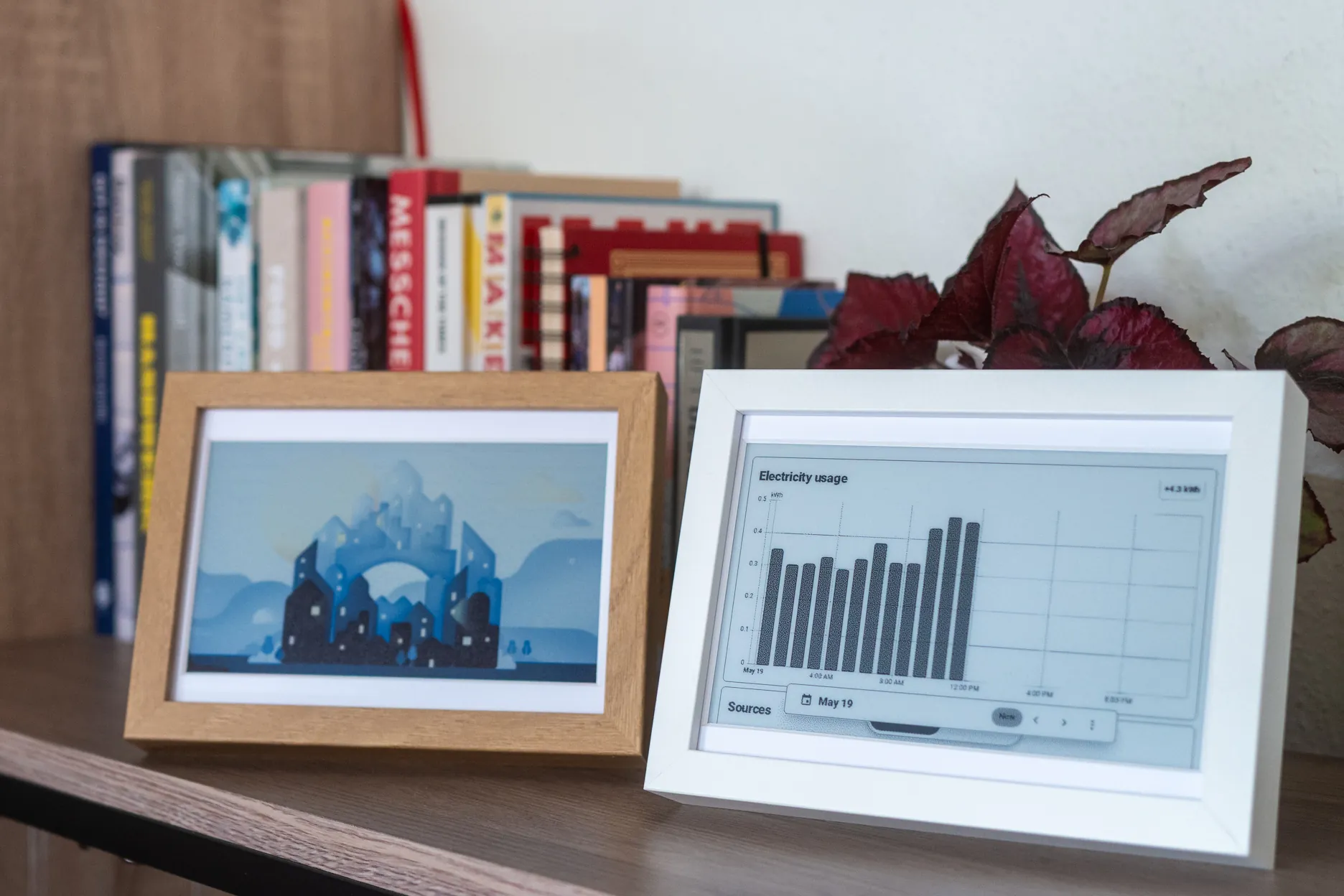
<img src="/assets/images/blog/welcoming-opendisplay-as-our-newest-collaboration-partner/image1.webp" alt="All sorts of projects are possible with e-paper displays!" style="border: 0;box-shadow: none;">
<p><em>All sorts of projects are possible with e-paper displays!</em></p>
<h2>The power of Bluetooth proxies</h2>
<p>For our community, this is where the fun starts. OpenDisplay can piggyback on the Bluetooth proxies you likely already have around your home – such as an ESP32 running <a href="https://esphome.io/projects/" target="_blank" rel="noopener noreferrer">ESPHome</a>. It uses that existing network to send any image you want, be it an illustration, weather dashboard, or calendar overview, straight to your e-paper displays. You're essentially using the infrastructure you've already built to keep everything local and fast, without ever needing the cloud.</p>
<h2>Why we're keen to collaborate</h2>
<p>We've always believed the Open Home is much bigger than any single project. The real magic happens when independent developers and communities unite to do great things together. Whether it's <a href="https://kno.wled.ge/" target="_blank" rel="noopener noreferrer">WLED</a>, <a href="https://www.zigbee2mqtt.io/" target="_blank" rel="noopener noreferrer">Zigbee2MQTT</a>, or now OpenDisplay, we love teaming up with people who are building the right tools for the right reasons. By supporting OpenDisplay, we're not just backing a great piece of software, we're helping ensure it remains a flourishing shared resource for everyone to use and enjoy 😃.</p>
<p>And of course, they also align with our core principles:</p>
<ul>
<li><strong>Privacy:</strong> Your data stays on your local network, never leaving your home.</li>
<li><strong>Choice:</strong> You aren't locked into a specific manufacturer's app or a cloud service that might disappear tomorrow.</li>
<li><strong>Sustainability:</strong> Low-power e-paper displays can run for months on a single battery and remain useful for many years to come.</li>
</ul>
<p>We can't wait to see where this partnership takes us. <a href="https://www.seeedstudio.com/" target="_blank" rel="noopener noreferrer">Seeed Studio</a> is already on board with reference hardware to get you started, and we're excited to see how the community expands on that. E-paper opens up so many avenues to explore: from dynamic artwork displays to simple, low-distraction dashboards that blend into your decor. Ready to dive in? Check out the <a href="https://opendisplay.org/" target="_blank" rel="noopener noreferrer">OpenDisplay documentation</a> to find out what's supported and how to get your first e-paper display up and running!</p>
]]></content>
  </entry>
  <entry>
    <title>Built on evidence: Research at the Open Home Foundation</title>
    <link href="https://www.openhomefoundation.org/blog/built-on-evidence-research-at-the-open-home-foundation/"/>
    <updated>2026-05-20T00:00:00Z</updated>
    <id>https://www.openhomefoundation.org/blog/built-on-evidence-research-at-the-open-home-foundation/</id>
    <author><name>Annika Schulz, Idil Bostan</name></author>
    <summary>From our first peer-reviewed paper to the decisions behind our projects: Open Home Foundation researchers Annika Schulz and Idil Bostan unpack how research shapes everything we do.</summary>
    <content type="html"><![CDATA[<p>Last month, two of us packed our bags and headed to Barcelona. Not for tapas (though there was some of that too), but to present the Open Home Foundation's first-ever peer-reviewed paper at <a href="https://chi2026.acm.org/" target="_blank" rel="noopener noreferrer">ACM CHI</a> – the leading international conference on Human-Computer Interaction 🎉</p>
<p>It was a milestone we'd been working toward for a long time. By publishing and presenting this research, we're putting evidence on the academic record that privacy-conscious users exist, and their needs are real and underserved. It reinforces one of our core beliefs: that smart homes need to be designed with privacy at the foundation, rather than something users have to retrofit.</p>
<p>But the paper is only part of the story. Behind it is a rigorous approach to research that shapes our work at the Open Home Foundation. In this post, we'll dig into our methods, what we're currently investigating, and why we think research and community go hand in hand.</p>
<!--more-->
<h2>From principles to a peer-reviewed paper</h2>
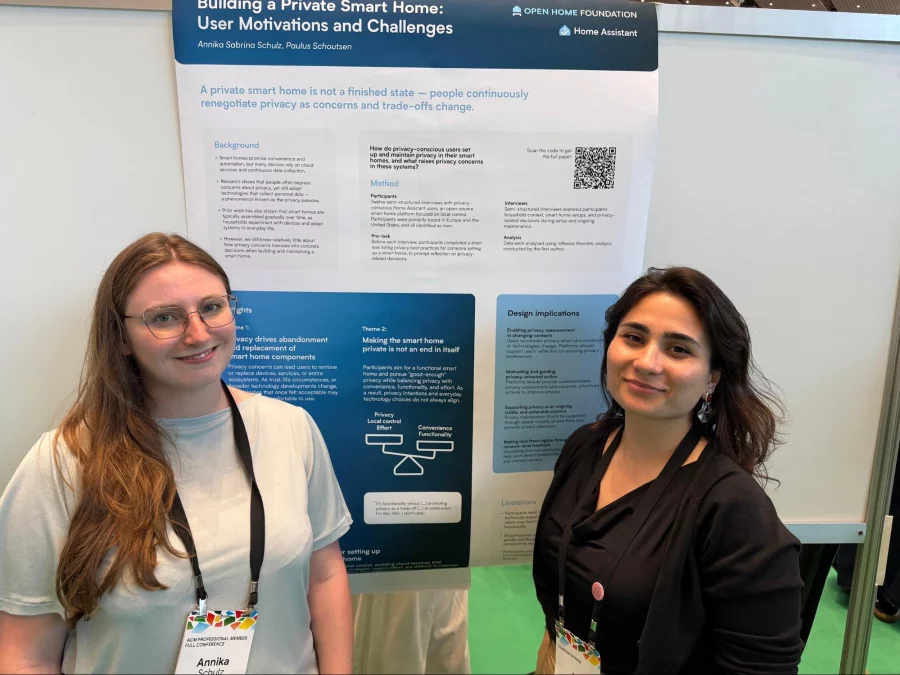
<p>Privacy is one of the core principles of the <a href="https://www.openhomefoundation.org/" target="_blank" rel="noopener noreferrer">Open Home Foundation</a>. So when the opportunity arose to explore the topic in a formal study, it felt like a meaningful place to start. <a href="https://github.com/OpenHomeFoundation/user-research/blob/main/Privacy%20Study/CHI26_shortpaper.pdf" target="_blank" rel="noopener noreferrer">Building a Private Smart Home: User Motivations and Challenges</a> – the paper Annika and Open Home Foundation President Paulus Schoutsen co-authored – investigated how privacy shapes the way users set up and maintain their smart homes. Specifically, what measures they take to ensure privacy in their homes, and what aspects of smart home tech make users uncomfortable due to privacy concerns, including when that might lead to them abandoning certain (big) technologies.</p>
<p>What the research illuminated was that privacy concerns in the smart home don't exist in a vacuum. Users are responding to a broader landscape, rife with data breaches, surveillance capitalism, AI trained on personal data, and data tracking for political gain. The desire for more private systems is real, and for many, it's already driving them away from technologies that don't meet that standard. That's exactly why we exist as a foundation: to fight for locally controlled, private smart home alternatives that put users back in control.</p>
<p>Presenting that work at ACM CHI meant bringing it to an event of more than 6,000 people: researchers, manufacturers, academics, and community members who care just as deeply about the future of smart home technology as we do, including many fellow Human-Computer Interaction (HCI) researchers – the field in which we both completed our PhDs. HCI is a discipline concerned with designing technology around human behavior, needs, and values: exactly the lens we bring to our work at the Open Home Foundation. We had rich conversations with people working across domains that feed directly into ours: privacy within IoT systems, bystander privacy for visitors and guests, prevention of technology-enabled violence in smart homes, family-centric smart home design, and more. That exchange of ideas – across disciplines, perspectives, and areas of expertise – is what these conferences are all about. And it doesn't stop in Barcelona.</p>
<img src="/assets/images/blog/built-on-evidence-research-at-the-open-home-foundation/image2.webp" alt="A four-photo collage from ACM CHI 2026 in Barcelona. Top left: two attendees pose in front of a &quot;Welcome to CHI 2026&quot; sign outdoors. Top right: the CHI '26 logo on a large conference screen, reading &quot;Barcelona, Spain | April 13–17, 2026.&quot; Bottom left: a packed conference auditorium with the SIGCHI logo on stage. Bottom right: an aerial view of a busy conference exhibition hall." style="border: 0;box-shadow: none;">
<p><em>Scenes from ACM CHI 2026 – from keynotes to the conference floor.</em></p>
<p>Whether you're a researcher, a community member, or just someone who cares about privacy in your smart home – we'd love to hear from you. Head to our <a href="https://github.com/OpenHomeFoundation/ux-design/discussions/26" target="_blank" rel="noopener noreferrer">UX design discussions page</a> on GitHub to share your insights (we read everything!). And if you'd like to go deeper into the research itself, check out the <a href="https://github.com/OpenHomeFoundation/user-research/blob/main/Privacy%20Study/CHI26_shortpaper.pdf" target="_blank" rel="noopener noreferrer">full paper</a> and <a href="https://github.com/OpenHomeFoundation/user-research/wiki/Privacy-Study" target="_blank" rel="noopener noreferrer">research wiki</a>, or if you only have a few minutes, take a peek at the <a href="https://github.com/OpenHomeFoundation/user-research/blob/main/Privacy%20Study/CHI-Poster.pdf" target="_blank" rel="noopener noreferrer">poster</a> we presented at the conference 👀</p>
<h2>Why we question what we build</h2>
<p>Research is one of the ways we ensure what we build solves a problem for the people who will actually use it. By making decisions that are informed by evidence instead of instinct, we not only reduce risk, but keep ourselves accountable to the people we're building for. Which brings us to a larger goal that's at the heart of everything we do: making sure what we create is genuinely human centered, not just technology centered (spoiler: it's harder than it sounds).</p>
<p>It's an iterative process that involves figuring out the right questions to ask, speaking to a broad range of people, and being honest about our biases and gaps in understanding. For example, being aware that our community doesn't represent our entire user base. The people who are active and vocal in our forums and discussions are invaluable, but they're also a small share of our users and we can't generalize their needs and opinions to everyone. That's why good research makes sure those other voices are heard, too. Because by getting a fuller picture of who users are and what matters to them, we're better placed to find real problems that smart home technology can solve.</p>
<p>Ultimately, every question leads back to you. But who's doing the asking?</p>
<h2>Meet the people behind the work</h2>
<p>Our work spans two interconnected areas: understanding the smart home landscape and the people within it.</p>
<p>Idil's focus as a Market Researcher in the Marketing department is how the smart home landscape is shifting, how people outside our community perceive and relate to our projects, and how we can better identify and serve the needs of the people already with us. With a background in cognitive neuroscience and doctoral research in healthcare technology, Idil has a particular interest in the growing convergence of home technology and personalized health, and what that means for how we design for people, not just devices.</p>
<p>Annika works within the Product &amp; UX department to understand what users actually want and need: who a new feature is for, what needs it addresses, and what aspects of the user experience need attention before it ships. Annika's PhD focused on cohabitation in smart homes – specifically what happens when one person sets up and maintains the technology, while the other person lives with it. The research investigated the dynamics of shared households, including the power imbalances that can emerge, and how couples negotiate control.</p>
<img src="/assets/images/blog/built-on-evidence-research-at-the-open-home-foundation/image1.webp" alt="Annika Schulz (left) and Idil Bostan stand in front of a research poster at ACM CHI 2026 in Barcelona. The poster, branded with the Open Home Foundation and Home Assistant logos, is titled &quot;Building a Private Smart Home: User Motivations and Challenges&quot; and lists Annika Schulz and Paulus Schoutsen as authors." style="border: 0;box-shadow: none;">
<p><em>Annika Schulz (left) and Idil Bostan presenting Open Home Foundation's privacy study poster at ACM CHI 2026 in Barcelona.</em></p>
<p>What unites our work is a shared belief that technology should be designed to be approachable to everyone. Our Product Manager Laura Palombi captured this perfectly at <a href="https://www.openhomefoundation.org/blog/building-whats-next-state-of-the-open-home-2026/" target="_blank" rel="noopener noreferrer">State of the Open Home 2026</a>: &quot;Approachability means thinking as a human is thinking and not as the machine wants you to think&quot;.</p>
<p>The question is how we actually understand what our users think, especially when our commitment to privacy rules out the research methods most tech companies take for granted.</p>
<h2>Built on consent, not cookies</h2>
<p>Let's address the elephant in the room: <em>data</em>. Research at the Open Home Foundation is shaped by a core tension: we want our projects to be grounded in evidence, <em>but we won't sacrifice our values to get there</em>.</p>
<p>This pushes us to seek privacy-sensitive data collection methods for understanding our users and informing decisions. We're crafting approaches designed to respect the community. For example, when conducting research, participants are explicitly asked to share information about themselves, their perspectives, opinions, and experiences based on informed consent – as described in our <a href="https://www.openhomefoundation.org/user-research-agreement/" target="_blank" rel="noopener noreferrer">User Research Agreement</a>. Translation: we want people to share on their own terms, and know their privacy is protected in the process.</p>
<p>While our approach can add challenges, meaningfully contributing to ethical research methods in service of our community, especially in the world of tech, is more than worth the effort.</p>
<h2>Research in action</h2>
<p>And it's this commitment to ethical research that has shaped our work from the start. Our research on the <a href="https://www.home-assistant.io/docs/automation/editor/" target="_blank" rel="noopener noreferrer">automation editor</a> – a tool that lets you create and edit automations directly from the Home Assistant user interface, without writing any YAML code – explored how users actually interact with one of Home Assistant's most-used features. And our research into how privacy-conscious users build and maintain their smart homes evolved into the study we presented at CHI.</p>
<p>That work doesn't stop. Right now, we're investigating user expectations of the <a href="https://works-with.home-assistant.io/" target="_blank" rel="noopener noreferrer">Works with Home Assistant</a> (WWHA) badge. Because some WWHA-certified devices have features missing in Home Assistant, we want to understand what users expect from the badge so we can align our certification decisions with that. This will also help us work out how to communicate any limitations so users can make genuinely informed purchasing decisions.</p>
<p>We're also conducting several studies in parallel, in which we ask questions about the work and field of professional smart home installers, learn from beginners about how we can help them find their footing in ESPHome, and observe how users familiarize themselves with the Dashboard Creator of Home Assistant.</p>
<p>All different questions, all driven by the same commitment: to make sure <em>your input</em> shapes what we build. And we want more people to be part of the discussion.</p>
<h2>Join the conversation</h2>
<p>From our work in Human-Computer Interaction, we know Home Assistant has already become a research tool in its own right, used across domains as a flexible way to build prototypes and integrate newly developed technologies into real setups (it's actually how Annika found her way to Home Assistant in the first place!). That crossover between practice and academia matters to us. Outside perspectives challenge us to think beyond what already exists, and that ultimately means more thoughtful technology and more choice for you – which is exactly why we want to stay connected to the people doing that work.</p>
<img src="/assets/images/blog/built-on-evidence-research-at-the-open-home-foundation/image3.webp" alt="A large group of conference attendees, including Open Home Foundation researchers Annika Schulz and Idil Bostan, pose for a photo in front of a screen displaying &quot;CHI '26 Meetup — Crossing the Academia-Practice Divide in Interaction Design: Bridging Silos in Academic Research and Professional Practice in Interaction Design.&quot;" style="border: 0;box-shadow: none;">
<p><em>The wider community we're proud to be part of – CHI '26's academia-practice divide meetup.</em></p>
<p>If you're a researcher working on smart home usage, interaction design, privacy, accessibility, or anything adjacent, we'd love to hear from you. We've set up a <a href="https://github.com/OpenHomeFoundation/user-research/discussions" target="_blank" rel="noopener noreferrer">dedicated space</a> on GitHub where you can share your work and start discussions: a place to exchange ideas, follow each other's work, and think together about what comes next.</p>
<p>The best version of smart home technology gets built when practitioners and researchers are in dialogue. Come be part of it!</p>
]]></content>
  </entry>
  <entry>
    <title>Building what's next: State of the Open Home 2026</title>
    <link href="https://www.openhomefoundation.org/blog/building-whats-next-state-of-the-open-home-2026/"/>
    <updated>2026-04-10T00:00:00Z</updated>
    <id>https://www.openhomefoundation.org/blog/building-whats-next-state-of-the-open-home-2026/</id>
    <author><name>Paulus Schoutsen</name></author>
    <summary>From a new Community department to a public roadmap awaiting your input – and more. Catch up on the event highlights and help shape what we build next.</summary>
    <content type="html"><![CDATA[<p>Welcome to the Open Home Foundation Blog! Until now, foundation updates lived alongside product-related news on the <a href="https://www.home-assistant.io/blog/" target="_blank" rel="noopener">Home Assistant Blog</a>. While that served us well in the early days, we've reached a turning point. We have big ambitions for the future, and the depth of our work – building open standards, growing our community, and spreading the word about our shared values of privacy, choice, and sustainability – demands its own stage.</p>
<p>So what better way to start than by sharing our vision from <a href="https://sotoh.openhomefoundation.org/" target="_blank" rel="noopener">State of the Open Home 2026</a>!</p>
<p>This big annual event is where we celebrate our community, share successes, and get excited about what's coming next: and this year it was extra special. But don't just take my word for it! Check it out for yourself on our full recording of the livestream.</p>
<p><lite-youtube videoid="XyAL1to3Lm4"></lite-youtube></p>
<script type="module" src="https://cdn.jsdelivr.net/npm/@justinribeiro/lite-youtube@1.5.0/lite-youtube.js"></script>
<!--more-->
<h2>The heart of the Open Home</h2>
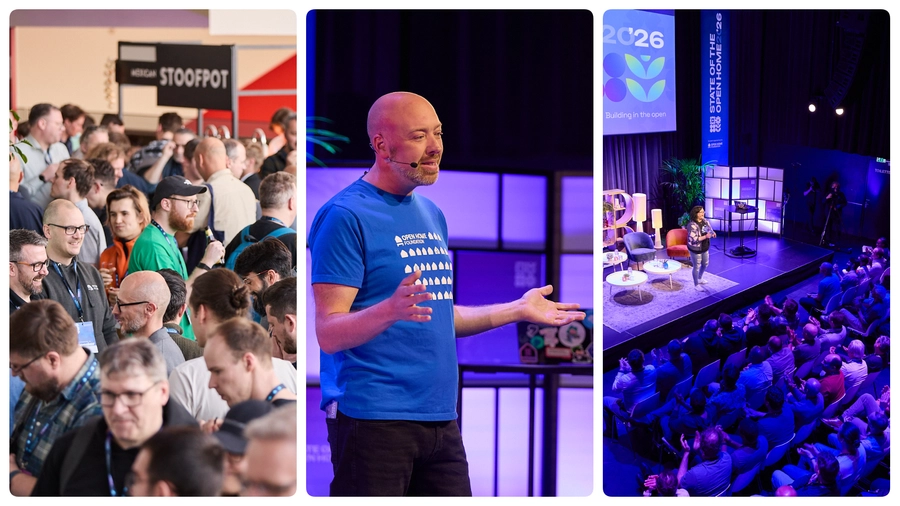
<p>If you can sense the energy and excitement in the video, I can assure you it was even more intense standing on that stage in Utrecht! Seeing almost 300 of you in person – with thousands more joining us online – was a powerful reminder of how far we've come together.</p>
<p>The theme of State of the Open Home 2026 was &quot;Building in the open&quot;. That's more than just a slogan: it's your invitation to help us ensure the future of smart homes is shaped by the people who actually use them.</p>
<img src="/assets/images/blog/building-whats-next-state-of-the-open-home-2026/image1.webp" alt="A three-panel collage showing a busy conference crowd networking, Open Home Foundation President Paulus Schoutsen speaking on stage in a blue T-shirt, and a large seated audience watching a talk under blue lighting." style="border: 0;box-shadow: none;">
<p><em>Kicking off the event, from packed halls to the main stage.</em></p>
<h2>Investing in people</h2>
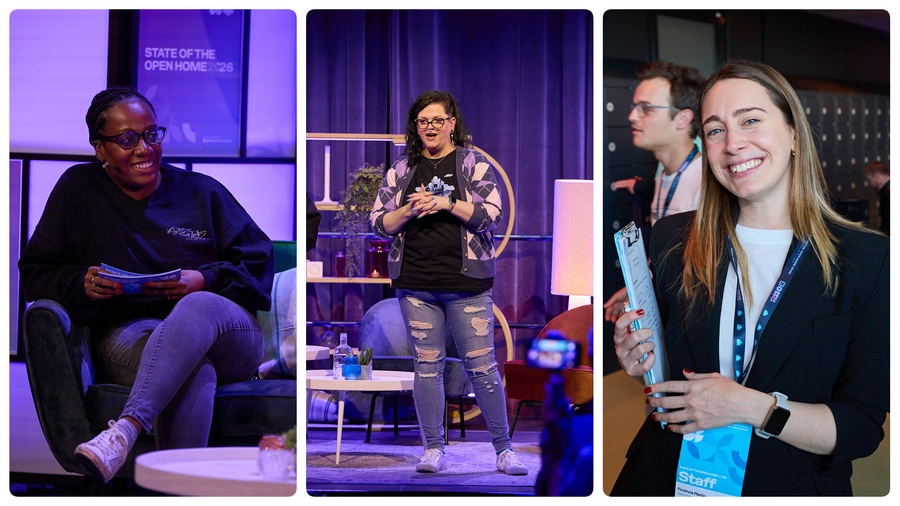
<p>But building in the open only works if we have the resources to support everyone involved. That's why the first thing we shared this year wasn't a feature reveal or secret product (we're <em>not</em> Apple!). It was the introduction of our new Community department, and its lead Melissa Thermidor! 🎉</p>
<img src="/assets/images/blog/building-whats-next-state-of-the-open-home-2026/image2.webp" alt="Three members of the new Community Department at an event: Melissa Thermidor seated on a stage set holding notes, Missy Quarry speaking on stage, and Florencia Martin smiling while holding a clipboard and wearing a staff badge." style="border: 0;box-shadow: none;">
<p><em>From left to right: Melissa Thermidor, Missy Quarry, and Florencia Martin – our new Community department!</em></p>
<p>Melissa's arrival shows we're putting our money where our mouth is. She brings a fresh perspective to the foundation, and a renewed focus on making sure everyone who finds their way to our community feels genuinely welcome. With our Event Organizer, Florencia Martin, and Community Manager, Missy Quarry, this new department is set up to move beyond maintaining the community to actively growing it. This means better support for contributors and volunteers, more resources for local meetups, and deeper connections with people building in the open all over the world.</p>
<blockquote>
<p>&quot;Community is no longer something that just happens around the edges – we're building something really big and really profound. This is the real deal.&quot;
– Melissa Thermidor, Lead of Community, Open Home Foundation</p>
</blockquote>
<h2>How we're building in the open</h2>
<p>So what does building in the open actually look like? It isn't always easy, that's for sure, and takes a level of vulnerability and coordination that closed-door companies rarely have to face. But the results speak for themselves.</p>
<p>The event explores three examples of how this approach is taking shape, and what it means for you:</p>
<ul>
<li><strong>With Home Assistant Labs:</strong> How we're inviting you to break, test, and influence our ideas while they're still being forged. You give us real-world feedback, and we evolve the design in the open.</li>
<li><strong>With Sendspin:</strong> How we're giving you the chance to contribute to features long before they're officially &quot;finished&quot;, by opening up new protocols like Sendspin while they're still evolving (with some pretty cool music demos thrown in for good measure 🎶).</li>
<li><strong>With our partners:</strong> How we're making it easier to find hardware you can actually trust. From Apollo's ESPHome Starter Kit, to Nabu Casa's new products with infrared (IR) and radio frequency (RF) 👀, it's all about giving you more choice.</li>
</ul>
<p>These examples are only the beginning. The goal this year is making everything more approachable, and as we say on stage: &quot;Approachability means showing all the context&quot;.</p>
<p>We want to open the doors even wider so you can see and contribute to what comes next. That means moving away from the &quot;black box&quot; of development and towards a model where every major milestone is a shared journey. And that starts with being clear about where we're headed.</p>
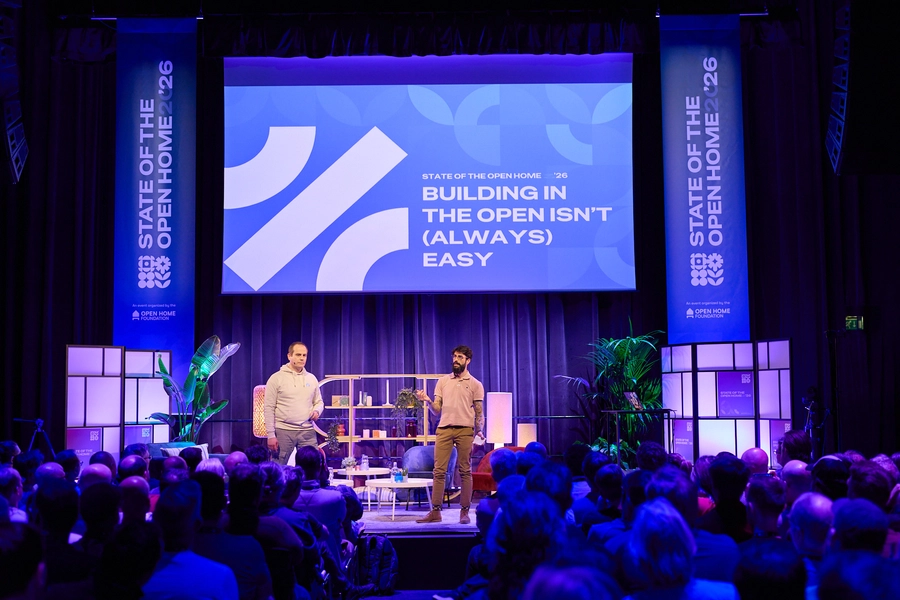
<img src="/assets/images/blog/building-whats-next-state-of-the-open-home-2026/image3.webp" alt="Franck, Home Assistant Lead, and JLo, Product and Design Lead, standing onstage presenting to a large audience, with a screen behind them reading Building in the open isn't (always) easy, and a softly lit set with plants and shelves." style="border: 0;box-shadow: none;">
<p><em>Franck (Lead of Home Assistant) and JLo (Lead of Product &amp; UX) sharing what it means to build in the open.</em></p>
<h2>Be part of what we build next</h2>
<p>That's why the final part of the event sees Laura and Matthias from our Product &amp; UX department join Franck and JLo on stage to talk about our <a href="https://github.com/orgs/OpenHomeFoundation/projects/8" target="_blank" rel="noopener">roadmap</a>, which is now public on GitHub!</p>
<p>As the team explains, what makes this roadmap different is that it's a living thing for you to <em>participate</em> in, not just view. We want to know what's missing and what you want to see next. Head to the roadmap, open the cards (demonstrated by Laura in the livestream), and tell us what you think. Because it's <em>your</em> insights and expertise that will help us build what's next.</p>
<p>Want to propose something that's not on the roadmap yet? Submit it on our <a href="https://github.com/orgs/home-assistant/discussions" target="_blank" rel="noopener">Home Assistant</a>, <a href="https://github.com/orgs/music-assistant/discussions" target="_blank" rel="noopener">Music Assistant</a>, or <a href="https://github.com/orgs/esphome/discussions" target="_blank" rel="noopener">ESPHome</a> feature requests pages. We read every single one, and selected features are translated into roadmap opportunities by the team.</p>
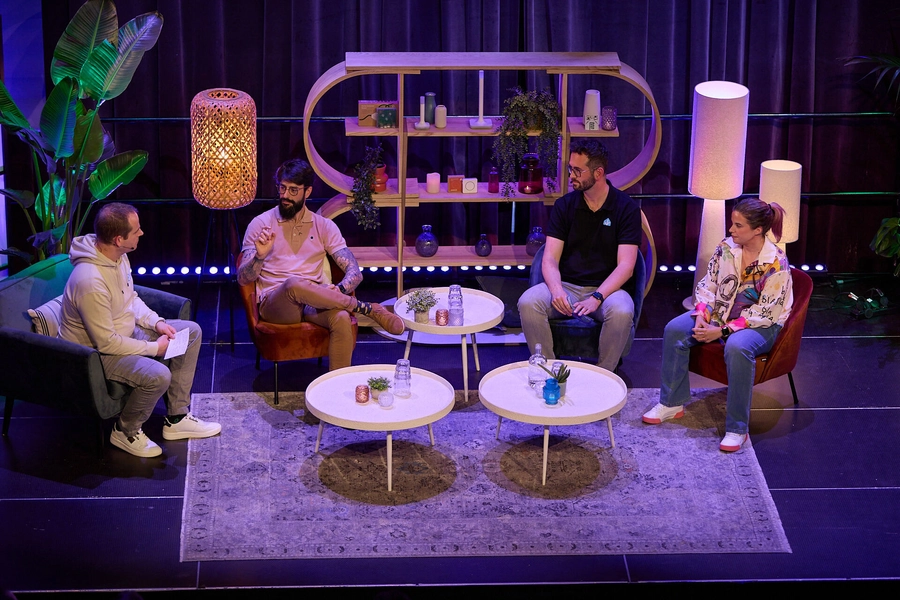
<img src="/assets/images/blog/building-whats-next-state-of-the-open-home-2026/image4.webp" alt="Four speakers—Frenck, JLo, Matthias, and Laura—seated onstage in a panel discussion, talking through the new roadmap, with low tables and a softly lit set behind them." style="border: 0;box-shadow: none;">
<p><em>From left to right: Franck, JLo, Matthias, and Laura chatting through the new roadmap.</em></p>
<h2>Your voice matters</h2>
<p>Crucially, this process isn't just for developers. Whether you're an established user or just getting started, your voice matters. Your experience in your own home is the most valuable resource we have… and you don't need to write a single line of code to help steer our direction.</p>
<p>That's because one of our biggest priorities is making Open Home Foundation projects – Home Assistant, Music Assistant, and even ESPHome – more approachable for anyone. We're reducing the barriers to entry, without removing any of the power established users expect. Or as Franck put it onstage: &quot;We really want to lower the floor without lowering the ceiling&quot;.</p>
<h2>Finally, thank you!</h2>
<p>Setting goals like this is only possible because of the community behind us. The energy we felt in Utrecht – and from everyone watching online – is an amazing reminder of what happens when we actually get together to share our ideas and experiences.</p>
<p>From the atmosphere onstage to the buzz of conversation and laughter at the food stands, there was a feeling at the event that no livestream can quite capture: being there in person was genuinely something special. If you couldn't make it this year, stay tuned – you won't want to miss the next one!</p>
<img src="/assets/images/blog/building-whats-next-state-of-the-open-home-2026/image5.webp" alt="Collage of post-event scenes showing attendees in small groups talking and socializing over drinks, interacting with smart home device demos, and chatting in softly lit indoor and evening settings." style="border: 0;box-shadow: none;">
<p><em>When the talks wrapped, the conversations kept going: drinks, demos, and all.</em></p>
<p>I'm so incredibly grateful that you're here building this with us: it's your passion, persistence (and, yes, patience!) that make all our work possible. On that note, I also want to give a huge thanks to all our State of the Open Home 2026 speakers and wonderful event staff who worked tirelessly behind the scenes to bring this production to life. It's been a blast.</p>
<p>For everyone who tuned in online, we'd love to hear your thoughts on how the event went. If you have a spare moment, take our (anonymous) <a href="https://docs.google.com/forms/d/e/1FAIpQLSeuqPALL5ilFLm_w1PTc3_m-fnMIG7TMI4DldpCtA2bQtCapA/viewform" target="_blank" rel="noopener">online attendee survey</a> and share your feedback and suggestions.</p>
<p>We couldn't do any of this without you. Let's keep building… and see you next year!</p>
<img src="/assets/images/blog/building-whats-next-state-of-the-open-home-2026/image6.webp" alt="A group of speakers and organizers standing together onstage, smiling and applauding in front of a large screen and event banners, marking the close of the event." style="border: 0;box-shadow: none;">
<p><em>And that's a wrap!</em></p>
]]></content>
  </entry>
  <entry>
    <title>Announcing the Open Home Foundation</title>
    <link href="https://www.openhomefoundation.org/blog/announcing-the-open-home-foundation/"/>
    <updated>2024-04-20T00:00:00Z</updated>
    <id>https://www.openhomefoundation.org/blog/announcing-the-open-home-foundation/</id>
    <author><name>Paulus Schoutsen, Guy Sie, Pascal Vizeli, J. Nick Koston</name></author>
    <summary>Actions speak louder than words. Which is why we created the Open Home Foundation to secure the radical principles of privacy, choice, and sustainability for smart homes.</summary>
    <content type="html"><![CDATA[<p>We created the Open Home Foundation to fight for the fundamental
principles of <strong>privacy</strong>, <strong>choice</strong>, and <strong>sustainability</strong> for smart
homes. And every person who lives in one.</p>
<p>Ahead of today, we've transferred over 240 projects, standards, drivers,
and libraries—<em>Home Assistant</em>, <em>ESPHome</em>, <em>Zigpy</em>, <em>Piper</em>, <em>Improv
Wi-Fi</em>, <em>Wyoming</em>, and so many more—to the Open Home Foundation. This is
all about looking into the future. We've done this to create a bulwark
against surveillance capitalism, the risk of buyout, and open source
projects becoming abandonware. To an extent, this protection extends
even against our future selves—so that smart home users can continue to
benefit for years, if not decades. No matter what comes.</p>
<p>But the work of the Open Home Foundation doesn't stop there. Through
close partnership with Nabu Casa, the foundation funds, directs
resources to, and collaborates on the development of critical external
projects like <em>Z-Wave JS</em>, <em>WLED</em>, <em>Rhasspy</em>, and <em>Zigbee2MQTT</em>. Our
main requirements are that the projects remain open to everyone, and
aligned with our core principles.</p>
<p>This is what we've already done.</p>
<h2>Our ambitions go further</h2>
<p>Our aim is to have the resources to be an active political advocate.
Serving to educate the public, public servants, and the companies making
smart home devices and services, about the importance of open standards,
open source projects, and privacy, choice, and sustainability when it
comes to the future of smart homes.</p>
<p>Here's how we understand these principles:</p>
<h3>Privacy</h3>
<p>Privacy means you control your data. Nobody, and no company or
organization, has a right to know what you do in your home, with whom
you meet or associate, or how you choose to live—without your explicit
permission. You should only share this information if you freely make
the choice to do so without external pressure. That's why your devices
need to work locally. It's OK for a product to offer a cloud
connection—but its main functionality should work without the cloud. And
the use of cloud services should always be opt-in and clearly described.</p>
<p>You should never have to worry about being yourself to avoid being
tracked or classified by an algorithm. You should be able to live your
life—because nobody is watching.</p>
<h3>Choice</h3>
<p>Choice means you have the freedom to use any device, with any other,
from any manufacturers, any way you like—for as long as you want. To
make this possible, vendors must not arbitrarily limit the
interoperability of their devices with the rest of your smart home.
Control of those devices, and management of data they gather, should
operate via open standards and local APIs.</p>
<p>You should be able to design your personal smart home—the way you
imagine it.</p>
<h3>Sustainability</h3>
<p>Sustainability means being able to use and repurpose old appliances,
smart devices, and other durable hardware beyond commercially-limited
lifetimes as your smart home evolves. But it also means having the tools
to limit your environmental impact by tracking, automating, and reducing
waste and emissions.</p>
<p>You should be able to embrace the convenience of a smart home without
compromising your ability to cut utility bills—and your carbon
footprint.</p>
<p><lite-youtube videoid="oa__fLArsFk"></lite-youtube></p>
<script type="module" src="https://cdn.jsdelivr.net/npm/@justinribeiro/lite-youtube@1.5.0/lite-youtube.js"></script>
<h2>Getting here didn't follow a linear path</h2>
<p>As many people in this community already know, the Home Assistant
Journey started over 10 years ago when Paulus Schoutsen wrote a few
lines of Python to take control of his Philips Hue smart lights. His
motivation was greater control over the devices he'd purchased—rather
than letting a corporate giant decide what was best for his home.</p>
<p>This act struck such a chord that over the coming years, thousands of
mostly volunteer contributors transformed that first script into a
leading smart home platform. They also built an entire ecosystem of
projects around it.</p>
<p>But two other critical trends also took place, one far more troubling:
The smart home landscape grew dominated by companies whose purpose was
to sell you new devices on a schedule to please their shareholders—while
siphoning off your personal data for financial gain.</p>
<p>The other trend was Schoutsen and others approaching burn-out as they
tried to keep their various projects thriving—doing most of their coding
after coming home from their real jobs, on weekends, and when bugs
needed squashing.</p>
<p>To address this, Schoutsen, Ben Bangert, and Pascal Vizeli founded Nabu
Casa in 2018 as a for-profit company. The goal was to stabilize Home
Assistant, and bolster its longevity, by injecting predictable funding
for future development. Nabu Casa also bought ESPHome, with the same
purpose in mind.</p>
<p>Early on, some people questioned whether starting a for-profit company
was an altruistic move. But over the following years, Nabu Casa
established a clear and accountable track record. This included
practicing what it preached: Speaking up to protect open source ideals
when other developers came under threat; directing full-time employees
to devote their days to open source, community-driven, smart home
projects; and joining organizations like the Connectivity Standards
Alliance and Z-Wave Alliance, and the general fight for critical open
standards like Zigbee, Z-Wave, and Matter.</p>
<p>By 2021, Schoutsen and others defined a concept called the open home,
built around the principles of privacy, choice, and sustainability. But
Home Assistant and other open home projects were still floating in a
kind of undefined space between a for-profit entity and an open source
repository on Github.</p>
<p>So in 2023, this core group of smart home developers decided to codify
and protect their ideals. And to create a formal home for the projects
they and so many other contributors had poured their souls, beliefs, and
shared code into.</p>
<p>Individual efforts needed to be united. And in 2024, the Open Home
Foundation was created to unite them—with a special, rules-bound,
inaugural partner in Nabu Casa to provide the majority of the funding.</p>
<h2>Going forward will be a journey</h2>
<p>Share your ideas. Speak up. Contribute. Subscribe. Support. Tell us
where we can do better. Champion our cause.</p>
<p>We see this as a living project, in fitting with the mosaic threads of
DNA that represent our past.</p>
<p>We've always stood for open source, creativity, and taking initiative.
And we have no doubt that this organization will evolve over the years.
We will remain true to our principles of privacy, choice, and
sustainability for the smart home. And always open to finding the best
way to achieve our goals.</p>
<p><strong>We hope you'll join us.</strong></p>
]]></content>
  </entry>
</feed>